How the EBA AML Risk Report is Changing Payments in the EU

Key takeaways
- The European Banking Authority (EBA) found payment institutions and their supervisors are not effectively identifying or mitigating ML/TF risks.
- The EU payments sector carries elevated, sector-specific money laundering and terrorist financing risks.
- The EBA identified concrete AML/CFT weaknesses and compliance breaches among payment service providers.
- Payment providers face growing regulatory pressure to strengthen their AML/CFT controls.
- Effective compliance requires robust risk assessment, monitoring and KYC processes tailored to payments risk.
The European Banking Authority (EBA) recently found that money laundering and terrorist financing (ML/TF) risks in the EU aren’t being identified and mitigated effectively by payments institutions and their supervisors.
Because of the high ML/TF risks innate to the payments sector and weak anti-money laundering and countering the financing of terrorism (AML/CFT) controls, the EBA’s suggestion that competent authorities are falling short in their duties is alarming.
‘EBA Finds That Money Laundering and Terrorist Financing Risks in Payments Institutions Are Not Managed Effectively’
The EBA published the results of its 2022 risk assessment of EU payment institutions on the 16th of June 2023.
The findings of this report reflect growing anxieties about the payments sector’s ability to comply with regulations, and what this means for the integrity of the EU’s financial ecosystem if payments institutions with weak AML/CFT controls are authorised to operate in Member States with less strict supervision and operate across the EU.
It’s a chastisement of payments institutions and supervisory authorities, but this report also gives key insight into the EU’s payments landscape relevant to any financial institution (FI) whose operations touch the payments system in any way.
Findings of this risk assessment will be feeding into the EBA’s bi-annual ML/TF risk assessment exercise and informing more in-depth assessment of emerging ML/TF risks like virtual IBANs and white labelling.
AML/CFT Risks Specific to the EU Payments Sector
The perception of the payments sector of being high-risk was echoed in The European Commission’s 2022 supranational risk assessment which stated it ‘appeared to be most vulnerable to risks arising from weaknesses in AML/CFT systems and controls’.
The EBA’s report also notes that payments institutions are often associated with higher ML/TF risks, including in the eyes of banks and other FIs. De-risking at FIs might see them decide to stop serving certain customers associated with higher AML/CFT risks, which poses an issue for payments services providers (PSPs) as it means they can’t access financial services.
To effectively mitigate financial crime risks, it’s crucial that PSPs both understand and use their customer and transaction data. The EBA report says that these firms don’t know their risk exposure well enough, and this comes from not knowing their customers’ KYC data accurately enough or applying this data to risk assessments.
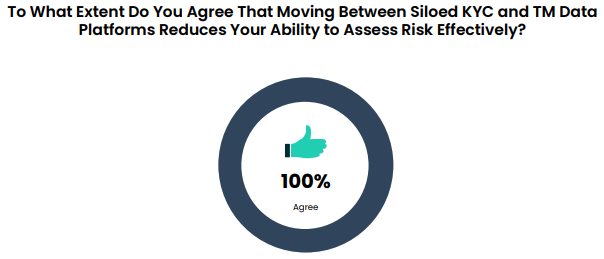
Unfortunately, fragmented data is common among financial institutions, creating data siloes across an organization. This data is housed in different systems, it becomes clunky, inefficient, and detrimental to overall anti-financial crime efforts. 100% of fintechs surveyed in a recent Fenergo report felt that moving between siloed KYC and transaction monitoring data platforms reduces their ability to assess risk effectively.
Verified, good quality KYC data, fed by transaction activity, would allow for a better understanding of customer risk. But, to achieve this, PSPs need to prioritize digitalization of key compliance processes and adopting a risk-based approach in line with the high risk exposure the sector is exposed to.
AML/CFT Weaknesses and Breaches the EBA Identified in the Payments Sector
The perception of supervisors is not only that the sector’s internal AML/CFT control systems are insufficient, but that payments institutions have less awareness of money laundering risks than FIs in the banking sector. This leads to their controls being ultimately inadequate to the ML/CF risks that the payments sector is exposed to, according to the EBA’s risk assessment.
The payments sector is the second most reported sector to EuReCA, the EBA’s AML/CFT database, after credit unions. Most breaches in the sector relate to ongoing monitoring, internal controls, policies and procedures, customer identification and verification of ID, and risk assessment at both a customer and business-wide level.
Harmonisation of regulation across the EU, in the manner that AMLA seeks to achieve, would even out the discrepancies in supervision and controls between member states, preventing PSPs or other FIs from operating across the EU with insufficient supervision for their risk profile.
The key weaknesses identified include:
How Payments Providers Can Achieve More Effective Compliance
Effective compliance and risk mitigation for PSPs comes down to adopting a community-based, risk-based approach that can assist in generating an appropriate template of pre- and ongoing risk assessment of their policies and procedures. This approach can help to safeguard against human error and automatically and accurately determine the risk of entities being onboarded, remotely or otherwise.
Adopting advanced technology systems for KYC and Transaction Compliance is one way that PSPs can help to improve their understanding of their customers’ risk profiles, and enable efficient, efficient compliance management.
Register for our upcoming webinar to find out how to manage AML risk in payments.
